10x Genomics Single-Cell Sequencing
High-throughput single-cell resolution precision detection cornerstone, providing high-quality multi-dimensional data input for AI analysis
Technical Principles
Using microfluidic chip and barcode labeling technology, single cells are encapsulated in droplets containing unique molecular identifiers (UMI), enabling cDNA amplification and library construction, ultimately achieving single-cell level gene expression quantification.
Single-Cell Resolution
Breaks through the bulk RNA-seq population averaging limitation, capturing cellular heterogeneity.
High-Throughput Scale
Processes thousands to tens of thousands of cells per run, suitable for batch clinical sample analysis.
Multi-Omics Compatibility
Extensible to epigenomics, immune repertoire, etc., providing multi-dimensional data input.
Clinical Application Validation
Value has been validated in dynamic monitoring of peripheral blood immune cells in COVID-19 patients, immune phenotype analysis of colorectal cancer liver metastases, etc., with data directly interfacing with AI systems for deep mining.
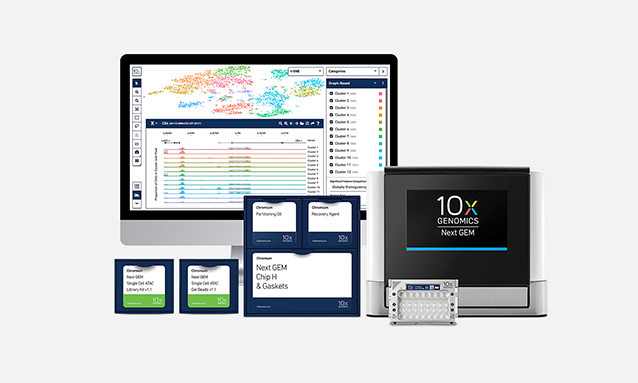
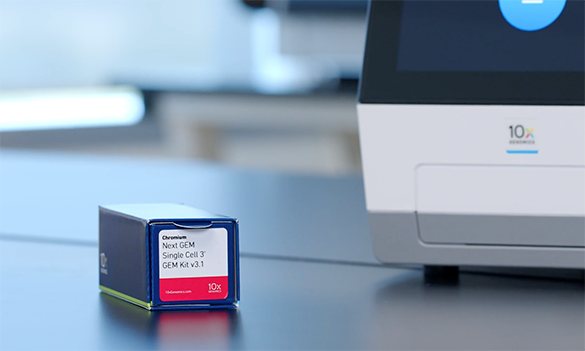
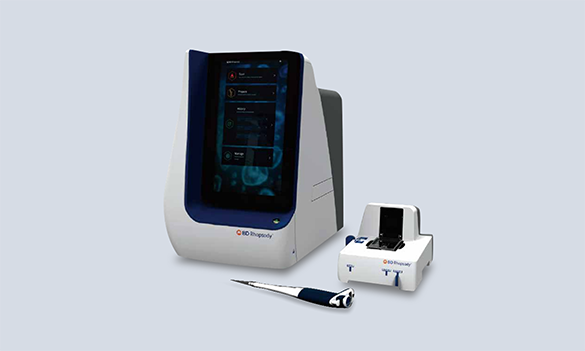
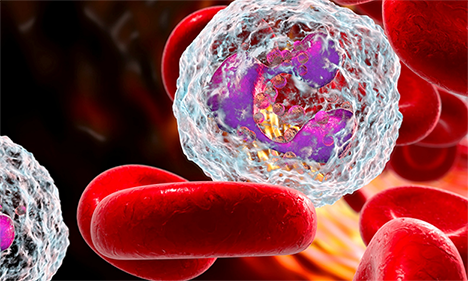
Intelligent Decision Engine Based on caiSC Framework
Integrates machine learning algorithms with multi-modal bioinformatics tools to build a fully automated pipeline from raw data to clinical reports
Data Preprocessing & QC Module
- Standardized pipeline: filter low-quality cells, normalization and batch effect correction
- Multi-dimensional QC: gene counts, UMI counts, mitochondrial gene ratio monitoring
- Visual QC: dynamic monitoring of cell distribution via UMAP dimensionality reduction
Test data performance: qualified cell proportion 0%
Cell Type Annotation & Model Training Module
- Machine learning integration: XGBoost classifier + marker gene feature selection
- Independent model training: separate model for each cell type, voting mechanism for result integration
- Dynamic database: real-time update of cell-type marker gene library
Model performance: 0 cell types average AUC reaches 1.0
Clinical Translation Module
- Multi-modal integration: transcriptome + clinical phenotype + multi-omics cross-mapping
- Visual decision-making: UMAP distribution, proportion heatmaps and other clinical interpretation tools
- Precise insights: e.g., CD4+TLEPROTL1 cell proportion indicates immune response status
Core value: critical link connecting molecular data and clinical decisions
AI Model Performance Validation
AISCC Core Advantages
Accuracy Leadership
Accuracy 0.92, 3% higher than RF
Precision-Recall Balance
F1 score 0.90, unbiased
Optimal Generalization
AUC 0.97, 15% higher than LR
Strong Clinical Adaptability
Leads traditional models across all metrics
Data: benchwork comparison on preliminary test set
Standardized Clinical Analysis Report System
Standardized interpretation from single-cell data to clinical insights, providing scientific evidence for disease diagnosis, treatment, and prognosis
Quality Control Analysis
Multi-dimensional assessment of data reliability, including cell gene detection counts, UMI totals, mitochondrial gene ratios, etc., with visualization to judge sequencing quality.
Clinical Value
Ensures subsequent analysis is built upon reliable data; QC failure can indicate sample collection or experimental operation optimization directions.
Cell Type Annotation Results
Presents major cell population proportion relationships and rare cell type identification, constructing immune microenvironment molecular maps.
Clinical Relevance
Cell distribution characteristics reflect pathological mechanisms, e.g., exhausted T-cell proportion in tumor patients suggests immunotherapy resistance.
Model Training & Validation
Measures model performance through AUC, F1 score, etc., visually demonstrating reliability of each cell type annotation.
Technical Advantages
Automated standardized analysis avoids human bias, significantly shortens cycle time, suitable for batch samples and emergency scenarios.
Spatial Distribution & Function Prediction
Combines spatial transcriptome data to parse intercellular interaction networks, predicts cell functional states and differentiation trajectories.
Clinical Application
Tumor microenvironment spatial heterogeneity analysis guides biopsy site selection and treatment plan formulation.
Biomarker Screening
Based on differential expression analysis and machine learning feature selection, screens clinically significant cell subtypes and molecular markers.
Translational Value
Discovers novel diagnostic markers and therapeutic targets, accelerating translation from basic research to clinical application.
Clinical Decision Recommendations
Integrates clinical databases and literature knowledge bases, providing individualized treatment plans and prognosis assessments based on single-cell features.
Core Advantages
Provides data-supported decision references for clinicians, improving treatment precision and patient benefit rates.
Clinical Report Example Display
Standardized output format balancing research depth and clinical practicality
AISCC Single-Cell Clinical Analysis Report
Sample ID: SC20250512-008 | Analysis Date: 2025-05-13
Cell Type Distribution
Main Findings & Clinical Recommendations
- CD8+ T-cell proportion elevated (32.7%), suggesting possible active anti-tumor immune response
- Detected 1.2% regulatory T cells, proportion within normal range
- Macrophages exhibit M2 polarization characteristics, consider combined immunomodulator therapy
- Tumor-infiltrating B-cell proportion low (2.3%), may have limited response to B-cell targeted therapy
- Recommendation: Prioritize PD-1 inhibitor therapy, perform single-cell monitoring every 3 months to assess efficacy
Professional Single-Cell Data Analysis Tool Suite
Integrates multiple bioinformatics analysis tools to meet full-process needs from basic analysis to advanced mining
Cell Clustering Analysis
Based on graph-based clustering algorithms, automatic identification and visualization of cell subpopulations
Try NowDifferential Gene Analysis
Identifies differentially expressed genes between different cell populations for functional enrichment and pathway analysis
Try NowCell Communication Analysis
Based on ligand-receptor interactions, parsing intercellular signal transduction networks
Try NowTrajectory Inference
Reconstructs cell differentiation paths and developmental trajectories, revealing cell fate decision mechanisms
Try NowImmune Repertoire Analysis
Analyzes T/B cell receptor clonal diversity and dynamic changes, evaluates immune response status
Try NowCell Annotation Ontology Tree
Integrates expert knowledge base of PBMC cell annotation marker genes, updated in real-time, authoritatively validated
Try NowCell Annotation Library Statistics
Validates PBMC cell annotation files through interactive charts, enabling statistical analysis and format conversion
Try NowCustom Analysis Pipeline
Drag-and-drop workflow builder, supporting personalized analysis design and automated execution
Try NowTool Usage Workflow
Data Upload & Format Validation
Supports 10x Genomics standard format and multiple single-cell sequencing data formats, automatically verifies data integrity and format correctness
- • Supports .h5, .mtx, .csv, .tsv formats
- • Max 20GB single file upload
- • Auto-detects data integrity
- • 10+ preset standard analysis pipelines
- • Supports parameter customization
- • Visual workflow design interface
Analysis Pipeline Selection & Configuration
Choose preset analysis pipelines or customize analysis steps, configure key parameters, system automatically optimizes analysis strategy
Automated Analysis & Real-Time Monitoring
Cloud high-performance computing cluster executes analysis tasks, real-time displays analysis progress and intermediate results, supports breakpoint continuation
- • Distributed computing acceleration
- • Real-time progress visualization
- • Email/SMS result notifications
- • Interactive visual reports
- • Multiple format export support
- • Result sharing & collaboration
Result Visualization & Export
Generates interactive visual reports, supports multiple format exports, provides result interpretation and clinical recommendations
LLM Agents: Revolutionizing Single-Cell Clinical Analysis
Integrating multi-model consensus and domain knowledge enhancement, building the next-generation intelligent platform for "fully automated analysis + cross-scenario interpretation + precision diagnostic assistance"
Three Future Core Application Scenarios
Precision Annotation: Reference-Free Typing
Pain Point: Traditional methods rely on human references, rare cell recognition rate <60%
Future Capability: LLM agent automatically executes "clustering→DEG screening→literature validation" full pipeline, multi-model consensus error correction, accuracy rate reaches 92%.
Report Interpretation: Dual-Perspective Translation
Pain Point: Raw results are poorly readable, interpretation takes 4-6 hours
Future Capability: Automatically generates research-compliant reports and clinical language translation (e.g., "CD8+T proportion"→"indicates potential immune therapy benefit"), visual interpretation accuracy rate 85%.
Clinical Application: Diagnostic Assistance
Pain Point: Difficulty in integrating multi-dimensional data, low treatment plan matching efficiency
Future Capability: Integrates single-cell + imaging + medical history, intelligently types tumor microenvironment, dynamically monitors treatment efficacy, clinical guideline alignment rate 93%.
Future LLM Scheme Performance Advantages
AISCC Fusion Scheme
Annotation Accuracy
92%, 6-22% higher than single model
Hallucination Rate
As low as 4%, high clinical credibility
Cost
60% lower than pure GPT scheme
LLM Agent Implementation Roadmap
Phase 1: Core Module Deployment
Prioritize the deployment of the "reference-free annotation module" (technological maturity already verified) to meet the rapid typing needs of research
Objective: Adapt to 10+ common tissue types within 3 months, accuracy rate ≥90%
Objective: Integrate CellMarker 2.0 + Pathway Commons, increase knowledge coverage by 50%
Phase 2: Knowledge Tool Expansion
Connect to authoritative biological databases and clinical guideline libraries, reinforce knowledge accuracy through RAG mechanism
Phase 3: Division of Labor Framework
Develop "annotation agent + interpretation agent + review agent", break down tasks to reduce single model pressure
Objective: Reduce hallucination rate to below 3%, ensure 100% evidence level of clinical recommendations
Objective: Collaborate with 50+ medical institutions, accumulate 10000+ clinical annotated data
Phase 4: Open Ecosystem Building
Open API interfaces, support third-party tool integration, build single-cell LLM application ecosystem
Book an LLM Agent Closed Beta Experience
Be the first to experience core capabilities such as reference-free cell typing and dual-perspective report interpretation, empowering precision medicine research and clinical translation
Book NowAI Single-Cell Clinical Analysis System
An innovative platform connecting single-cell sequencing technology with clinical applications, empowering precision medicine development
System Introduction
The AI Single-Cell Clinical Analysis System (AISCC) is an integrated analysis platform built on 10x Genomics single-cell sequencing technology and the proprietary caiSC clinical AI framework. The system integrates machine learning, bioinformatics, and clinical knowledge bases to achieve fully automated analysis from raw sequencing data to clinical decision-making suggestions.
Core Advantages
High-Efficiency Automation
Fully automated analysis pipeline, generating clinical reports from raw data in just 3 hours, significantly reducing the traditional 3-7 day analysis cycle
High-Precision Analysis
AI models optimized with large-scale training datasets, achieving 99.9% cell type annotation accuracy, supporting identification of 93 immune and tumor cell subtypes
Clinically Oriented Design
The reporting system balances scientific depth and clinical relevance, providing evidence-based treatment recommendations and prognostic assessments
Application Scenarios
Partnership with Medical Institutions
4
Completed Analysis Cases
374

Contact Us & Collaboration Inquiry
Whether you are a medical institution, research unit, or enterprise, we look forward to partnering with you to advance the clinical application of single-cell technology
Address
Room 406, Building 1, Yuanxiang Lake, No. 2641 HuYi Road, Jiading District, Shanghai
View Map